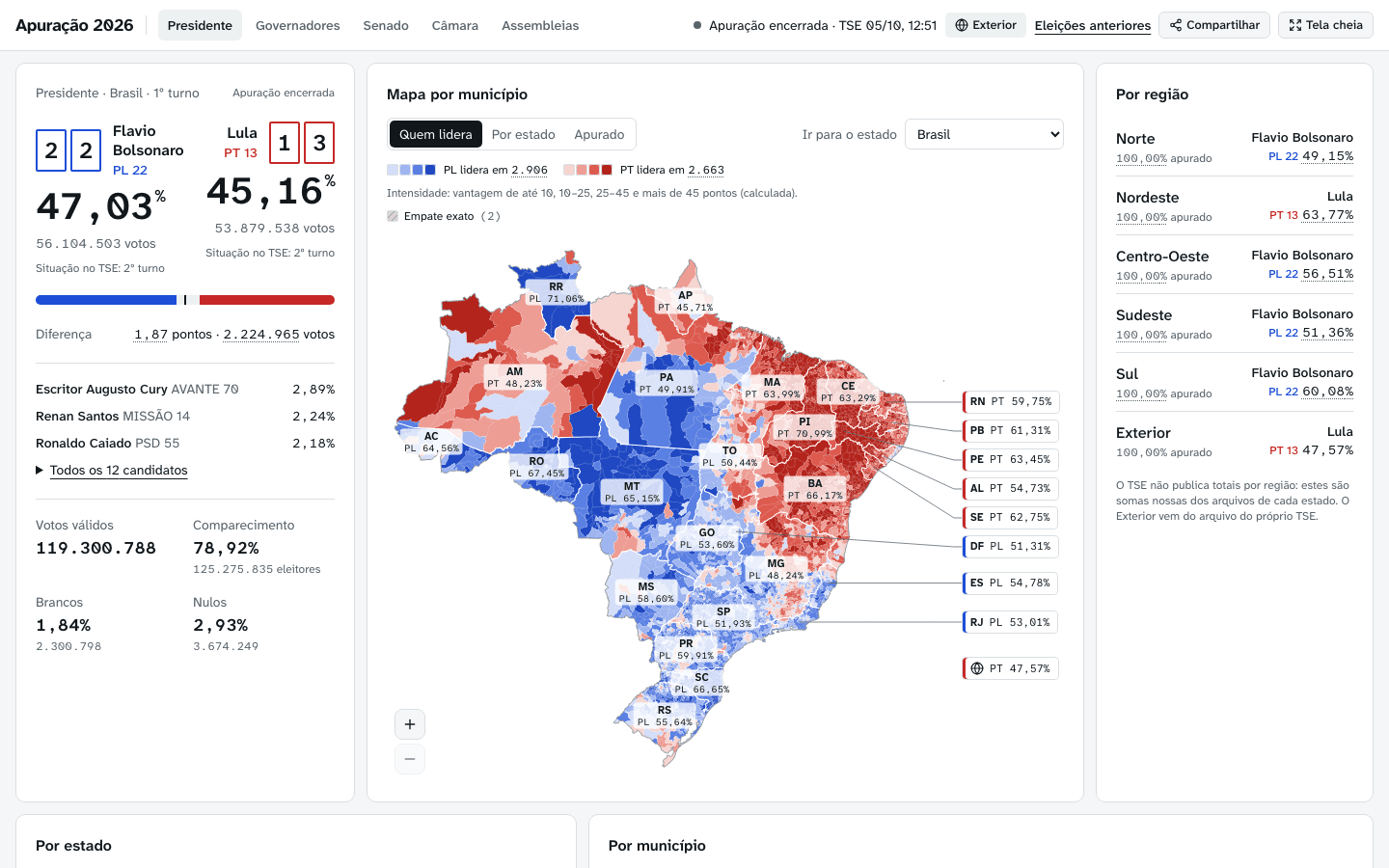
The TSE publishes the count as signed files on a CDN that overwrites them every minute; once the night is over, the history is gone. A dashboard on election night also has to survive a viral spike unattended, and every number on it has to be checkable against the official source rather than trusted.
— Case study 15
Apuração 2026
Brazil's election night, recorded file by file so the count can be replayed

project overview
A live vote-count dashboard for Brazil's 2026 elections, built on the TSE's official signed results feed, with a recorder that keeps every version of every file and a static site that never touches the backend.
shipped outcome
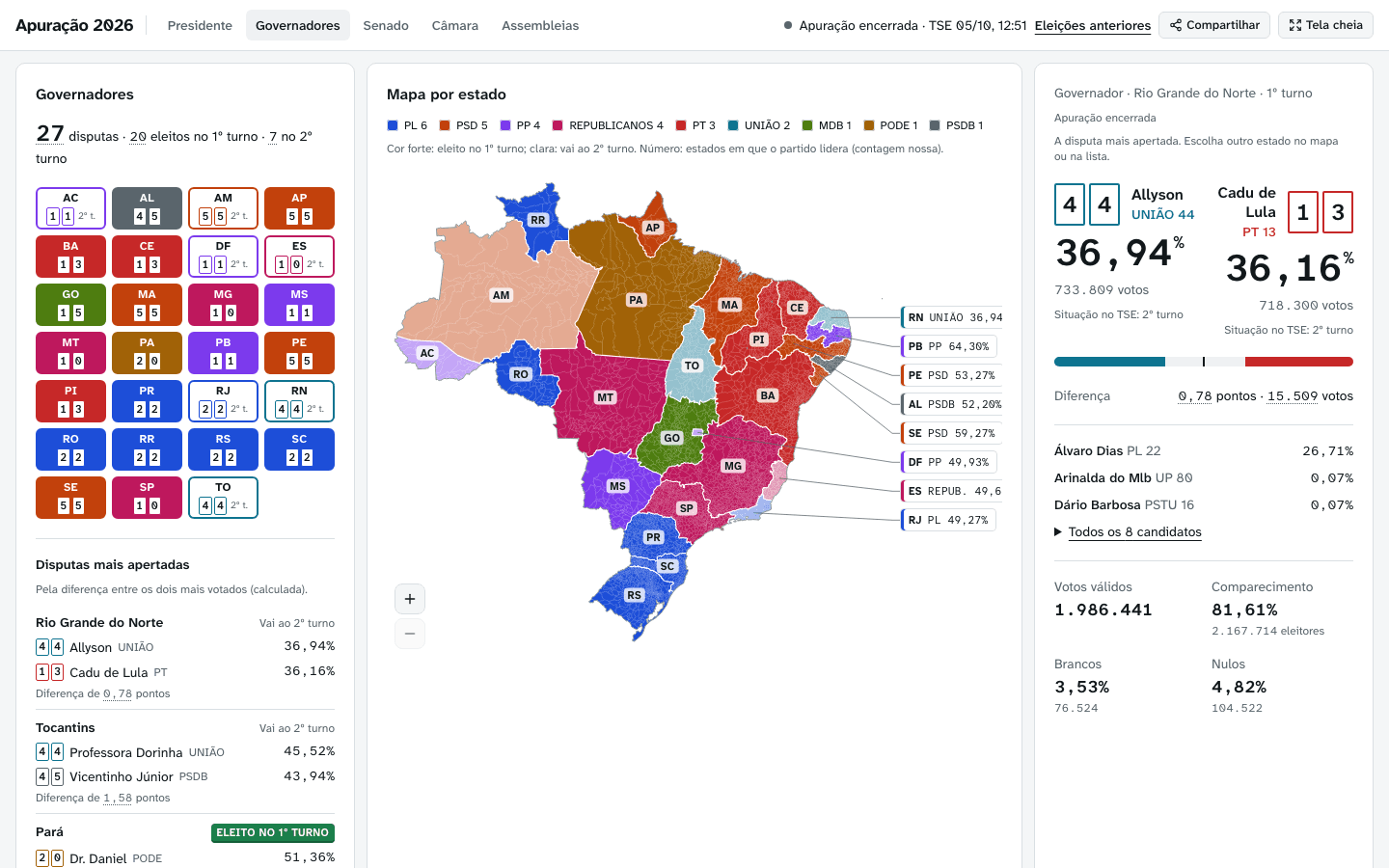
The recorder has been live on AWS since 8 October and captured the 1st round. The site shows president and governor results with a municipality map, a legislative archive with hemicycles, and an archive of every presidential election since 1994, municipality by municipality, organised as questions. The 2nd round is recorded live on 25 October.
- Role
- Architecture, data engineering and front-end
- Timeline
- Ongoing — 1st round live, 2nd round 25 October
- Year
- 2026
- Team
- Solo delivery
A recorder on Fargate polls the feed under a self-imposed ceiling of 100 requests a second, keeps each signed file byte for byte in an Object-Lock bucket addressed by its hash, and holds a lease in S3 so two recorders can't both write. A projector folds that log into immutable views with a pure function, so the published data can be rebuilt from scratch at any time. Readers only ever hit static files behind a CDN. A fake TSE replays the captured 1st round at twenty times speed for end-to-end rehearsals.
The recorder has been live on AWS since 8 October and captured the 1st round. The site shows president and governor results with a municipality map, a legislative archive with hemicycles, and an archive of every presidential election since 1994, municipality by municipality, organised as questions. The 2nd round is recorded live on 25 October.
— Interface evidence
The product, not a placeholder
These are the verified interface captures from the project build. Scroll inside taller frames to inspect each complete page.


— Delivery process
From operating constraint to shipped system
The work is sequenced around risk. Domain rules and failure states come before interface polish; automation arrives before handoff.
Read the feed before designing
How the TSE's files are signed, cached and replaced was measured and written up first; capacity numbers came from those measurements, not guesses.
Record first
The recorder went live on AWS days before the 1st round, so the night was captured even before the site was finished.
Rehearse on the real night
The captured round replays through a fake TSE with the CDN's caching semantics, recorder and projector included, at twenty times speed.
Answer questions, not tables
The 1994–2022 archive is organised as questions a reader actually asks, with every calculated number marked as ours and explained on hover.
— System architecture
Clear boundaries, explicit responsibilities
Each layer has one job and a narrow contract. That keeps external services replaceable and product behavior testable.
tse / 1º turno
5,757 municipalities
every version, byte for byte
rate ceiling
100 req/s · 16 in flight
raw log / s3
Recorder on Fargate
Conditional requests under a rate ceiling; an unchanged cycle costs about one request a second.
S3 with Object Lock
Every signed version stored by hash, retained; the source of truth for everything downstream.
Projector, a pure fold
Immutable published views, rebuildable from the raw log with one command.
Next.js static export
Served from S3 behind a CDN; a spike can't reach ingestion and a stall can't take the site down.
— What shipped
Product capabilities
Provably faithful
Every number traces to a TSE-signed file that was stored, and anyone can check the signature.
No projections
No forecasts, no calls and no interpolation between observed versions; a gap in the record is shown as a gap.
Ours versus theirs
Percentages are the TSE's own; anything calculated here is underlined and explains itself.
— Engineering pressure
Challenges resolved
History the source deletes
The TSE keeps only the latest state of each file, so the minute-by-minute count exists only if it was recorded while it happened.
A rehearsal signed with a fake key
Replayed files need valid signatures; they're signed with a throwaway key that the recorder and projector refuse to accept against a production bucket.
Archive files that change underneath you
The TSE regenerated a 2022 archive with its rows reordered, so content identity was redefined to ignore row order and rebuilt from the archived copy.
verified project destinations
next transmission
Need a system this deliberate?
Bring the operating problem. We will shape it into a clear product brief and a buildable next step.
Start a project